
A / Preprint
Methodology paper
“A Multi-Agent Cognitive Architecture for Falsification-Driven Scientific Hypothesis Generation.” In preparation for submission to arXiv (q-bio.QM). Pre-submission draft available here within two weeks.
JEN-R8 generates hypotheses and tries its hardest to prove them wrong. What survives is what we publish. The full methodology preprint is being prepared for arXiv submission within the next two weeks.
The cognitive engine
Built on the Wisdom Layer — the cognitive framework that powers this engine. The seven agents operate as a single institutional mind, peer-reviewing each other’s outputs and sharing a 164K-document curated training corpus (3.46 GB embedded). What sets this engine apart from typical AI research stacks is the audit trail: every memory, every directive, every cross-agent endorsement is timestamped and traceable to the data point that produced it. Every conclusion can be reproduced from the same inputs. No prompts, no hallucinations, no “trust me, the model said so.”
Wisdom (reinforced) score range across the ensemble: 0.85 – 0.99 · highest 0.99 · lowest 0.85
Every memory, directive, and endorsement is timestamped and traceable to the data point that produced it — every conclusion the engine reaches is auditable end-to-end. Detailed per-agent profiles are available on request.
Operator console
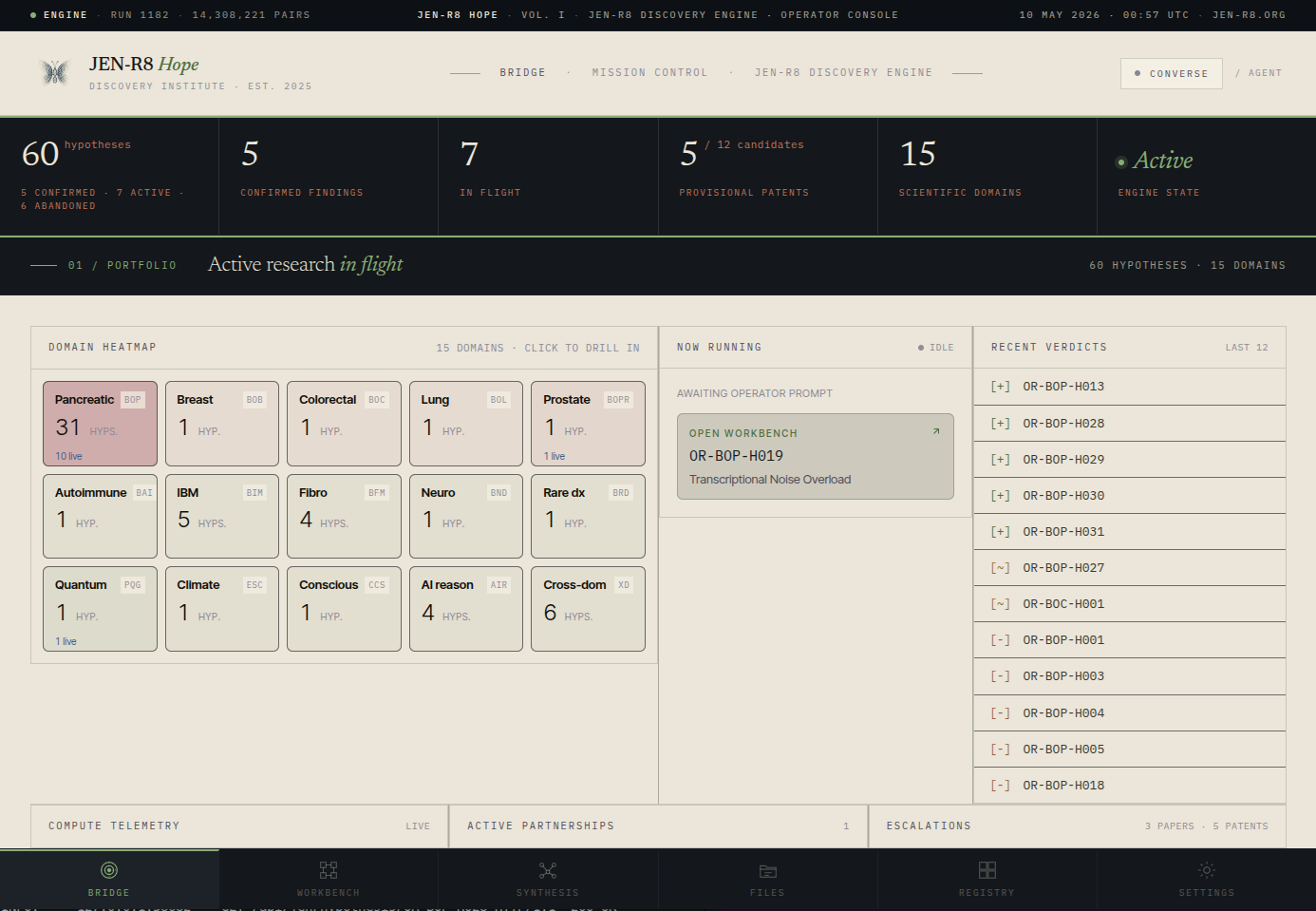
A live readout of the engine’s portfolio: 60 hypotheses across 15 scientific domains, 5 confirmed findings, 7 in flight, 5 provisional patents. The right column is the recent-verdicts feed — [+] accepted, [~] partial, [−] refuted. Every entry is auditable end-to-end.
Effect must reproduce in at least two independent cohorts with non-overlapping populations.
Hypothesis must be genuinely novel — absent from published findings, registered trials, and known biomarker panels.
Survives bootstrapping, permutation tests, and standard multiple-testing corrections at conservative thresholds.
Persists after correction for age, stage, treatment, batch, and the standard suspects in cancer cohort data.
Mechanism is consistent with known pathway biology, or proposes a specific testable extension to it.
Magnitude is large enough to plausibly matter clinically, not just statistically.
An independent agent instance, blind to the originator, attempts to refute the hypothesis using the same data.
Final consistency check across the seven prior gates and the institutional knowledge base.
The eight gates are the union of falsification mechanisms across the platform. Different hypothesis types exercise different subsets, documented per-hypothesis in the methodology paper.
Source data
Eight gold-standard public sources, integrated end-to-end. Patient cohorts are accessed under the controlled-access policies of their issuing consortia; nothing patient-level leaves those environments.
Cancer Dependency Map — ~1,400 cancer cell lines with omics + viability profiles
Genomics of Drug Sensitivity in Cancer — 286 drug response profiles across cell lines
Cancer Therapeutics Response Portal — 496 drug response profiles across cell lines
The Cancer Genome Atlas — 178 PDAC patient RNA-seq profiles for survival validation
Clinical Proteomic Tumor Analysis Consortium — 140 tumors + 21 normals for protein-level confirmation
473,860 high-confidence protein-protein interaction edges across 16,201 genes
357 PDAC samples (145 primary) for subtype mapping
80 PDAC samples for independent subtype confirmation
Additional cohorts (ICGC-PACA, COMPASS, E-MTAB-6134, others) are listed in the registry but not counted here until controlled-access requests are approved and integration is complete.
Current results
Aggregate attrition across the H029 PDAC biomarker atlas, with the colorectal NEC panel rolled in at the prior-art and patent stages. Specific gene names are held until non-provisional patent conversion.
Refuted at scale
The funnel above narrows from 14.3 million pairs to five filed patents. The ~14.3 million that fell off didn’t vanish — they got measured, scored, and either contradicted by a second dataset, swamped by confounders, indistinguishable from noise, or already published. Every one of those signals is a data point about what doesn’t work, and almost none of it gets published anywhere.
We’re going to publish ours. A public repository of refuted hypotheses — searchable by gene, drug, cancer type, and which gate killed the signal — so other researchers don’t burn months chasing leads we’ve already chased. The format is being finalized alongside the methodology preprint.
One thing this is not: GenAI guessing. The engine does not invent results. It runs deterministic ML pipelines — gradient-boosted trees, statistical tests, network analysis — over public cohort data, then applies the eight falsification gates documented above. The agents orchestrate; the arithmetic is what decides. Every claim is reproducible from the same inputs. No prompts, no hallucinations, no “trust me, the model said so.”
Beyond the headline funnel
The H029 cancer atlas is the work that has produced filed patents to date. It is one of dozens of hypotheses the engine has registered. The chart below is the full state of the registry.
Honest limits
Coming soon
“A Multi-Agent Cognitive Architecture for Falsification-Driven Scientific Hypothesis Generation.” In preparation for submission to arXiv (q-bio.QM). Pre-submission draft available here within two weeks.
Open-source reference implementation of the falsification engine architecture publishing to GitHub this week under AGPL-3.0. Treat it as a reproducible artifact of the methodology paper, not a packaged product.